How to Recover From ADHD Burnout, and the Question That Helps You Sort It Out
Recovering from what people call ADHD burnout starts with working out which of three things is producing the exhaustion, because only one of them responds to rest. Under-treated ADHD does not. A co-occurring condition such as depression does not. Occupational burnout in the formal sense does, at least partly, because its load can be lowered. The recovery genre built around this phrase routes all three to the same answer, and that answer is only partly right for one of the three and wrong for the other two.
The exhaustion is not imaginary. The label attached to it is doing something else, describing a life-wide collapse with a word defined for a workplace phenomenon. ADHD burnout is a description that has travelled a long way ahead of its evidence, and the advice attached to it has travelled further still.
If you are having thoughts of harming yourself, contact the 988 Suicide and Crisis Lifeline by calling or texting 988 in the United States, or your local emergency number. This publication does not offer therapy, and nothing written here replaces assessment by a licensed professional.
The term has no definition, and that is not a technicality
There is no clinical definition of ADHD burnout. It is not in any diagnostic manual. The National Institute of Mental Health's page on ADHD sets out what the condition is, how it presents across inattention, hyperactivity and impulsivity, what it co-occurs with and how it is treated, and the phrase does not appear on it anywhere.
The nearest thing to a formal definition of burnout belongs to somebody else. The World Health Organization's ICD-11 entry classes burn-out as an occupational phenomenon rather than a medical condition, files it under factors influencing health status rather than under illnesses, and defines it by three dimensions: energy depletion or exhaustion, increased mental distance from one's job along with cynicism about it, and reduced professional efficacy.
Compare that definition against what the ADHD burnout genre actually describes, which is usually a life-wide collapse in executive function that has little to do with any particular job. The WHO's own text closes that door explicitly. It states that burn-out refers specifically to phenomena in the occupational context and should not be applied to describe experiences in other areas of life.
So the word is being borrowed, and the thing it is being borrowed to describe is not the thing it was defined for. When a term has no definition, nothing anchors the advice attached to it. Stage models, recovery timelines and severity bands can be published for it without contradicting any source, because there is no source to contradict.
Our published work on how long burnout recovery actually takes traces the same failure in the general case, where confident recovery timetables circulate with no authority underneath them.
What the exhaustion is usually made of
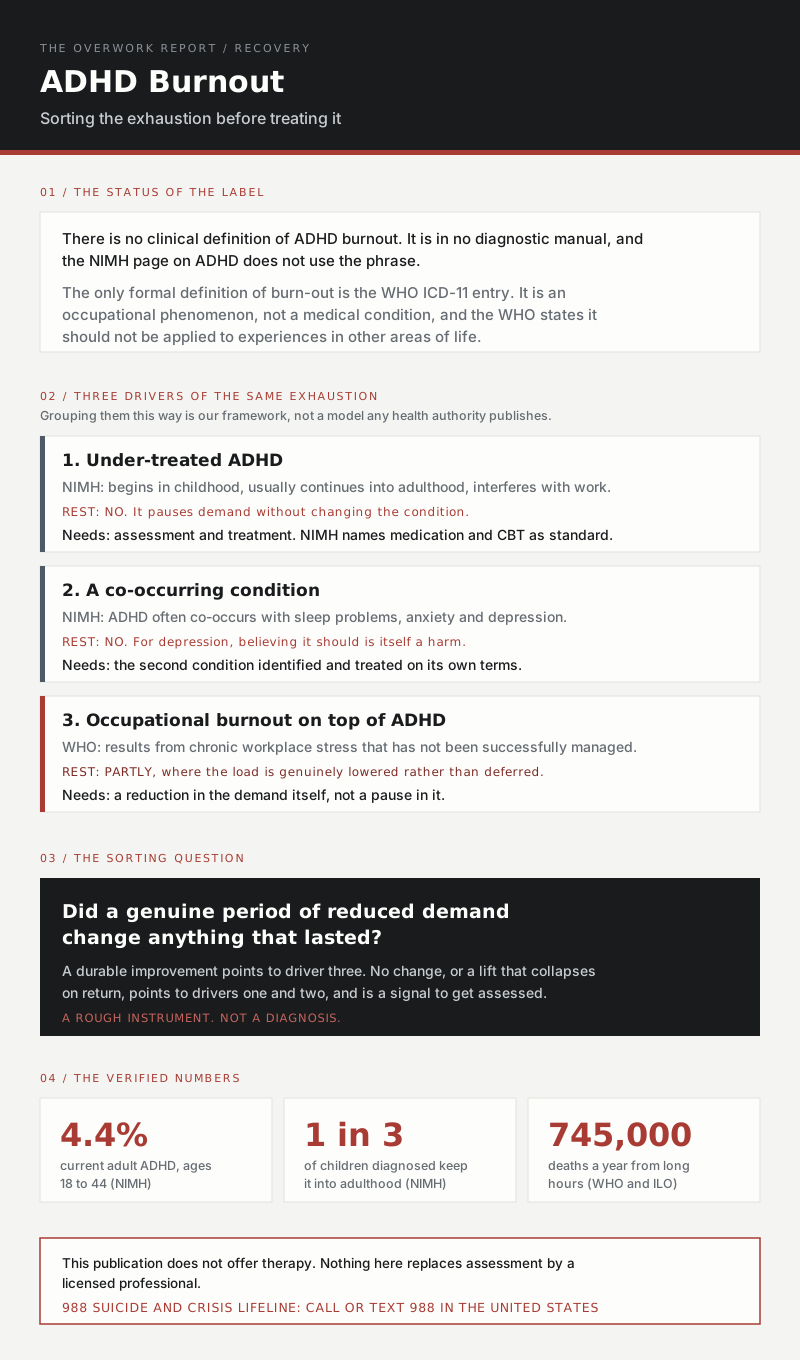
Set the label aside and look at what is documented. Three things are capable of producing sustained exhaustion, attention collapse and loss of function in an adult with ADHD. Health authorities describe each of the three separately. Grouping them as three routes to one presentation is this publication's own framework, not a model any of those authorities publishes.
| Driver | What the sources record | Does rest resolve it? (our reading) | What it needs (our reading) |
|---|---|---|---|
| ADHD itself, under-treated or untreated | NIMH records that symptoms begin in childhood and usually continue into adulthood, and that they interfere with work and daily life | No. Rest pauses the demand, it does not change the condition | Assessment and treatment. NIMH names medication and psychosocial interventions including cognitive behavioural therapy as standard |
| A co-occurring condition | NIMH records that ADHD often co-occurs with sleep problems, anxiety and depression, and that this makes the conditions harder to diagnose and treat | No, and in the case of depression the belief that it should is itself a harm | Identifying the second condition and treating it on its own terms |
| Occupational burnout on top of ADHD | WHO defines it as resulting from chronic workplace stress that has not been successfully managed | Partly, where the load can genuinely be lowered rather than deferred | A reduction in the demand itself, not a pause in it |
The reason this sorting step comes first is that the three have overlapping surfaces and opposite responses. Someone in the second case who follows first-case advice risks losing months. Someone in the third case who treats it as a personal failure of coping never touches the thing producing it.
Driver one, the ADHD itself
NIMH records that ADHD symptoms begin in childhood and usually continue into the teen years and adulthood, and that for many people those symptoms cause problems in daily life, make it hard to get things done and interfere with work. It also records that adults with ADHD are at increased risk of poor job performance and financial problems.
The scale is in its national statistics. Drawing on diagnostic interview data from the National Comorbidity Survey Replication, NIMH puts the prevalence of current ADHD among United States adults aged 18 to 44 at 4.4 percent, and lifetime prevalence in that age band at 8.1 percent. It also records that approximately one third of children diagnosed with ADHD retain the diagnosis into adulthood.
Our reading of that record is a standing operating condition rather than an episode. If the exhaustion is the accumulated cost of running an unsupported executive system across years, then a fortnight off changes the demand for a fortnight and changes nothing about the system. The exhaustion returns on the same schedule as before.
Under-treated covers two different readers. One has never been assessed. The other holds a diagnosis and a plan that is no longer carrying the load, which can mean a medication review years overdue, or a plan that only ever addressed attention and never touched sleep or executive function. Both belong in this driver, and more rest serves neither.
What NIMH names as standard treatment is medication and psychosocial interventions including cognitive behavioural therapy. Newer approaches it lists are neurofeedback, cognitive training, mindfulness and neuromodulation. That is a different category of action from the recovery-kit advice on the first page of results, and it is the category that has evidence behind it.
Driver two, the condition wearing ADHD's clothes
This is the one worth the most care. NIMH states that ADHD often co-occurs with other disorders and conditions including sleep problems, anxiety and depression, and that this co-occurrence makes the conditions harder to diagnose and treat.
Take sleep first, because it is the most reversible and the most commonly missed. The National Heart, Lung, and Blood Institute's account of sleep deficiency records that a sleep-deficient person may have trouble making decisions, solving problems, controlling their emotions and behaviour, and coping with change, along with problems paying attention. Set that list beside a description of ADHD burnout and the two are close to indistinguishable. NIMH separately notes that NIH-supported research highlights sleep as a target for early ADHD intervention. That work concerns early intervention rather than adult symptom management, so read it as a reason to take sleep seriously and not as evidence that fixing sleep resolves adult ADHD. Our reporting on what sleep loss does to the mind covers the mechanism in detail.
Depression is the case where the default advice does active damage. Depression does not remit because someone rested. Months spent treating it as burnout is months of untreated illness, and in this publication's view the reader risks drawing a false lesson about themselves from the failure. NIMH's guidance on caring for your mental health is the appropriate starting point, and assessment by a professional is the step that separates the two.
Driver three, real occupational burnout underneath
The third case is the one the WHO definition was actually written for, and having ADHD does not exempt anyone from it. If the work itself is the source, the load is the thing to change.
The scale of that load is documented. The World Health Organization and International Labour Organization joint estimates attribute 745,000 deaths from stroke and ischaemic heart disease in a single year to long working hours, and record a 35 percent higher risk of stroke for those working 55 hours or more a week compared with 35 to 40 hours. That is an environmental exposure, not a personal deficiency, and it is not fixed by any amount of individual coping.
Where this driver is the live one, the actions that matter are structural: hours, scope, and what gets declined. We have written separately on setting boundaries at work and on recovering without quitting, which is the situation most readers are in.
The question that sorts them
One question does most of the sorting work. It is a rough instrument, it is not a diagnosis, and it cannot tell you which condition you have. It only suggests which professional conversation to open, which is the decision the first page of search results does not help with. With that stated plainly, here is the question.
Did a genuine period of reduced demand change anything that lasted?
If a real break, meaning days without the demand rather than a weekend spent catching up, produced a durable improvement, the load was a live contributor and driver three is in play. If a real break produced nothing, or produced a lift that collapsed within days of returning, the load is not the whole story and drivers one and two need examining. That is a signal to get assessed rather than to rest harder.
If you have never had a real break to test against, which is the common case and often the reason the search got typed in the first place, the question cannot answer anything yet. Treat assessment as the default in that situation. Two of the three drivers need it regardless of how any future break turns out, so it is not a step you lose by taking early.
While you wait for an appointment
Assessment is the right next action in two of the three cases, and in much of the United States it is weeks or months away. That gap is real, and nothing here closes it. Three things are worth doing inside it, all drawn from what the sources already establish rather than from any protocol for a condition that has none.
Protect sleep first, because it is the most reversible of the three drivers and the one most likely to be quietly doing the damage. The NHLBI list of what sleep deficiency does to decision-making, emotional control and attention is the same list people bring to an ADHD burnout search, so removing sleep debt is both a possible fix and a way of clearing the picture before assessment.
Write down what actually happens, with dates. What the clinician needs is not a self-diagnosis but a record: when the exhaustion is worse, what a genuine break did and did not change, how long the pattern has run. That record shortens the appointment and improves it, and it is the one piece of preparation nobody else can do.
Lower what can genuinely be lowered at work. If driver three is present at all, this is treatment rather than waiting, and if it is absent the attempt tells you that. Our reporting on setting boundaries at work and on recovering without quitting covers how to do it without resigning.
What this supports, and what it does not
What is supported: ADHD is a real, documented, treatable condition that continues into adulthood and interferes with work. Sleep problems, anxiety and depression commonly travel with it. Occupational burnout has a formal definition, and that definition is about work. Each of those three has a different evidenced response.
What is not supported by any source we could verify: stage models of ADHD burnout, recovery timelines for it, severity bands, and the quizzes built on them. Those are constructions. They may describe someone's experience accurately and still have nothing underneath them, and none of them should be used to decide whether to seek assessment.
We also cannot tell you how long it takes. Nobody can, because the thing has no definition and therefore no measured course. Anyone publishing a number for it is inventing one.
Test yourself
Key takeaways
FAQ
How do you recover from ADHD burnout?
Sort it before treating it, using the table and the sorting question above. Rest only reaches the workload driver, and only partly. The other two need assessment, so if you are choosing one action today, book that rather than another week off.
Is ADHD burnout a real diagnosis?
No. It appears in no diagnostic manual, and the only formal burn-out definition in circulation is the WHO's, which is occupational rather than clinical. See the sourcing under "The term has no definition" above. The exhaustion is real either way, and a label carries no weight in getting it treated.
How long does ADHD burnout last?
Nobody can say, and the reason is set out under "What this supports, and what it does not" above. Treat any site that quotes you a confident number as having invented it.
Is ADHD burnout the same as autistic burnout?
They are different, and autistic burnout has more behind it. Autistic burnout has a published research definition from 2020 built on interviews with autistic adults, which we cover in our piece on recovering from autistic burnout. ADHD burnout has no equivalent defining study.
Why does rest not fix ADHD burnout?
Rest only addresses the workload driver. It does nothing for the other two, which is why it fails on repeat for most people who try it, and why a failed break is information rather than a personal failing.
Should I get assessed for ADHD if I think this describes me?
Use the sorting question above. If a genuine break did not produce a lasting change, that is the signal, not another round of rest. Recognising yourself in this description is a reason to book an assessment, not a reason to skip one, and because ADHD frequently co-occurs with other conditions the sorting is a job for a clinician rather than a quiz.
What should I do first if I am struggling badly right now?
If you are having thoughts of harming yourself, contact the 988 Suicide and Crisis Lifeline by calling or texting 988 in the United States, or your local emergency number. If you are not in crisis but are not coping, a conversation with a clinician about assessment is the highest-value first action, ahead of any recovery protocol found online. This publication does not provide therapy, diagnosis or assessment. A licensed professional does.
Last reviewed by The Overwork Report Editorial Team on September 23, 2026. Our sourcing and AI-use rules are public on the editorial standards page.
Sources
- 988 Suicide and Crisis Lifeline (988lifeline.org)
- National Institute of Mental Health's page on ADHD (nimh.nih.gov)
- World Health Organization's ICD-11 entry (who.int)
- national statistics (nimh.nih.gov)
- National Heart, Lung, and Blood Institute's account of sleep deficiency (nhlbi.nih.gov)
- caring for your mental health (nimh.nih.gov)
- World Health Organization and International Labour Organization joint estimates (who.int)