The Mental Effects of Sleep Deprivation, Starting With the One That Does Not Feel Like a Symptom
The mental effects of sleep deprivation are almost always listed with depression at the top. The largest experimental synthesis ever run on the question puts something else there, and it is the effect least likely to send anyone looking for help. Sleep loss removes positive feeling more reliably than it adds negative feeling.
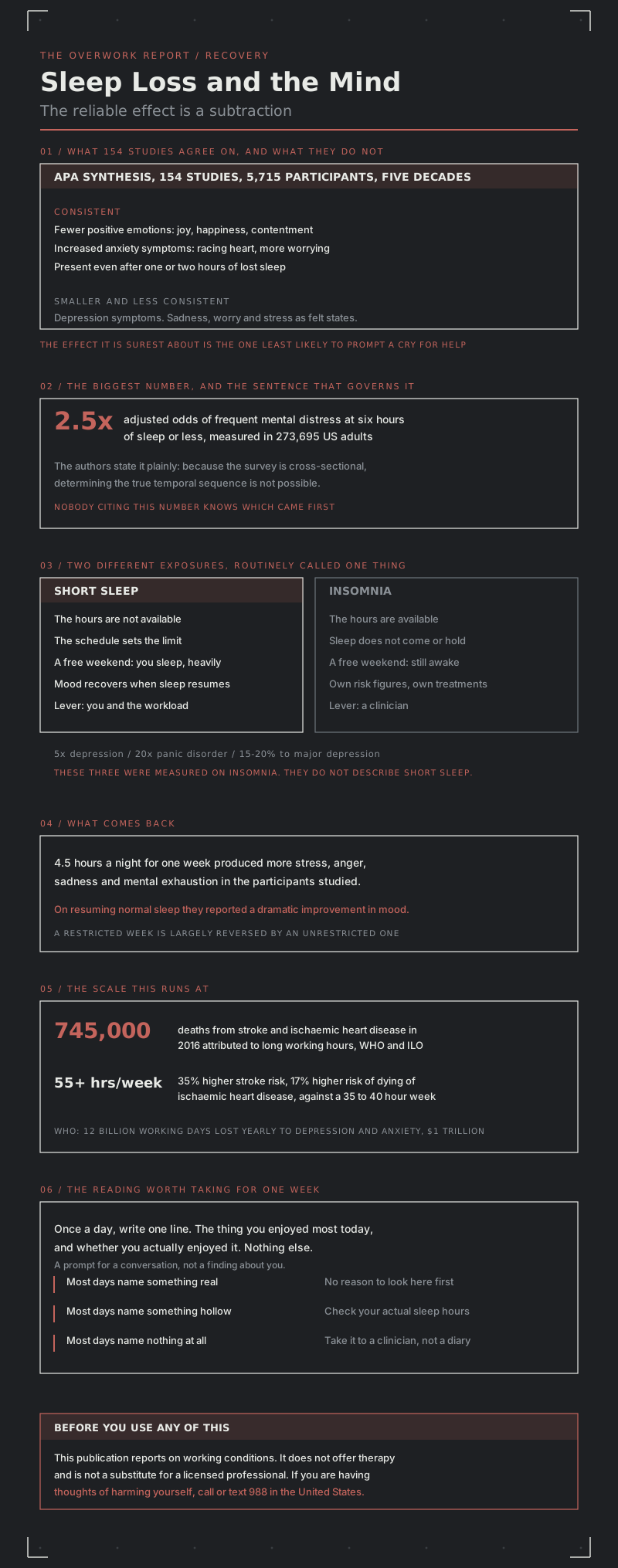
The American Psychological Association reported that across 154 studies spanning five decades and 5,715 participants, every form of sleep loss tested produced fewer positive emotions such as joy, happiness and contentment, along with increased anxiety symptoms such as a rapid heart rate and increased worrying. In the same analysis, findings for symptoms of depression were smaller and less consistent, as were those for negative emotions including sadness, worry and stress. The effect the evidence is most confident about is a subtraction.
That distinction decides what you go looking for. An addition announces itself. If sleep loss reliably made you sad, you would notice being sad and you would have a word for it. A subtraction does not announce itself at all. Nothing arrives. The week is simply flat, food is fine rather than good, the work you used to want to do is now work, and the natural conclusion is that the week was flat, or the job has gone stale, or something has quietly changed about you.
If you are having thoughts of harming yourself, contact the 988 Suicide and Crisis Lifeline by calling or texting 988 in the United States, or your local emergency number. This publication reports on working conditions. It does not offer therapy, and nothing here replaces a licensed professional.
If you are reading this at two in the morning
What follows takes a week to run, because the reading it asks for is a pattern and not a snapshot. If you are awake right now and want something for tonight, there are only two useful things to say.
The first is that a single bad night is not the thing this page is about, and treating it as one is how people turn one bad night into four. The second is that you should not make the decision you are currently turning over. Sleep loss does measurable damage to decision making, and the National Heart, Lung, and Blood Institute lists trouble making decisions, solving problems, controlling your emotions and behaviour, and coping with change among its documented effects. Whatever you are deciding at two in the morning will still be there on Thursday, and you will be a better instrument for it then.
The most reliable mental effect is a subtraction
Read the APA finding closely, because the ordering inside it is the whole point.
Palmer and colleagues, published online in Psychological Bulletin on 21 December 2023, analysed 154 studies in which researchers deliberately disrupted participants' sleep for one or more nights. Some participants were kept awake for extended periods, some were given a shorter than usual night, and some were woken repeatedly through the night. All three manipulations produced the same result: fewer positive emotions, and more anxiety symptoms. The lead author noted that this occurred even after short periods of sleep loss, of the order of staying up an hour or two later than usual.
The depression result was the weaker one. So were sadness, worry and stress as felt states. The sturdy, repeatable finding in fifty years of experimental work is that sleep loss turns the good down, not that it turns the bad up.
For someone working long hours this is the difference between catching it and missing it. The question people are taught to ask themselves is whether they feel depressed or anxious, and for many overworked people the honest answer is no. The question the evidence supports is narrower and much easier to answer truthfully: when was the last time something was actually enjoyable. Not tolerable, not fine, not a relief that it was over. Enjoyable.
Which way the arrow runs, and why the biggest number cannot tell you
The number you will meet most often on this subject comes from a study of 273,695 US adults, and it is usually quoted without the sentence that governs it.
Using 2018 Behavioral Risk Factor Surveillance System data, Blackwelder, Hoskins and Huber found that adults averaging six hours of sleep or less had nearly threefold unadjusted odds of frequent mental distress, defined as fourteen or more days in the past month when self-reported mental health was not good. After controlling for age, marital status, income, smoking status and education, the association held at roughly 2.5 times the odds, with a confidence interval from 2.32 to 2.73. Thirteen percent of participants had inadequate sleep and 14.1 percent had frequent mental distress.
Then the authors say the thing the summaries drop. Because the survey is cross-sectional, determining the true temporal sequence is not possible. They are explicit that the historical reading of this relationship ran the other way, with poor sleep treated as a symptom of existing mental distress rather than a cause of it, and that their own design cannot separate the two.
This is not a weakness worth hiding. It is the most practically important fact on the page. If your sleep is short because the work is long, the lever is the work. If your sleep is short because something is keeping you awake that is not a deadline, the lever is not a schedule and the person to see is not your manager. Almost every popular article on this subject picks one of those two readings and states it as settled. The study everyone is citing declines to.
Short sleep and insomnia are two different exposures, and the alarming numbers belong to one of them
The most frightening statistics in this field get attached to sleep deprivation in general. They were measured on insomnia, which is a different thing, and the distinction changes who a given number applies to.
Harvard's Division of Sleep Medicine, in its Sleep and Mood material, reports that in one study of 10,000 adults people with insomnia were five times more likely to develop depression and twenty times more likely to develop panic disorder, and that between 15 and 20 percent of people diagnosed with insomnia go on to develop major depression. The same page notes the traffic in the other direction, stating that difficulty sleeping is sometimes the first symptom of depression, and quotes Dr Lawrence Epstein to the effect that people who are depressed or anxious often have trouble with sleep as part of those disorders.
| Short sleep from a long schedule | Insomnia | |
|---|---|---|
| What the constraint is | Hours available for sleep are limited by the work, the commute or the caring load | Hours are available and sleep does not come, or does not hold |
| What happens on a free weekend | You sleep, often a great deal | You lie there with nothing scheduled and still do not sleep |
| Which numbers apply | The experimental sleep restriction findings, which show mood recovering when normal sleep resumes | The five times and twenty times figures, and the 15 to 20 percent progression to major depression |
| Who moves the lever | You and whoever controls your workload | A clinician, and there are effective behavioural treatments |
| What the wrong reading costs | Months spent on sleep hygiene advice that cannot reach a diary problem | Months spent renegotiating a schedule while an untreated condition continues |
If you have the hours and cannot use them, you are not reading the right page, and the useful next step is a clinical one rather than an editorial one.
What comes back when you sleep, and what does not
The experimental literature carries some genuine good news, and it is specific enough to act on.
Harvard's material describes University of Pennsylvania research in which participants limited to 4.5 hours of sleep a night for one week reported feeling more stressed, angry, sad and mentally exhausted. When those participants resumed normal sleep, they reported a dramatic improvement in mood. The same source puts it plainly for the single night case: after a sleepless night you may be more irritable, short tempered and vulnerable to stress, and once you sleep well your mood often returns to normal.
So the mood effects of a restricted week are, on the evidence, largely reversible by an unrestricted week. That is a much narrower and much more useful claim than the timetables that circulate online, and we have written separately about why burnout recovery timetables that quote weeks and months by severity have no health authority behind them.
| Reading | What the evidence supports | What it does not support |
|---|---|---|
| One sleepless night | Irritability, short temper, vulnerability to stress, with mood often returning to normal once you sleep well | Any conclusion about your job, your relationship or your character |
| One restricted week at about 4.5 hours | More stress, anger, sadness and mental exhaustion, with dramatic improvement reported on resuming normal sleep | Treating the week as evidence of a developing illness |
| Months of short sleep set by the schedule | A working condition worth naming and changing, and one the WHO ties to measurable physical risk at the extreme | An expectation that one good weekend settles it |
| Hours available, sleep absent | A pattern with its own name, its own risk figures and its own effective treatments | Anything a schedule change on its own is likely to fix |
Where overwork enters, and where it stops
This publication covers work, so it is worth being exact about which part of this is a work problem.
The schedule is a work problem when the hours available for sleep are set by the job. That is the case the World Health Organization and International Labour Organization measured at the extreme end, estimating that long working hours led to 745,000 deaths from stroke and ischaemic heart disease in 2016, and that working 55 hours or more per week is associated with an estimated 35 percent higher risk of stroke and a 17 percent higher risk of dying from ischaemic heart disease compared with working 35 to 40 hours. Those are cardiovascular findings rather than psychiatric ones, and we quote them here only to make the point that the hours themselves are a measurable exposure and not a lifestyle preference.
The direction of travel also runs the other way at scale. The WHO's own fact sheet on mental health at work puts the global cost of depression and anxiety at an estimated 12 billion working days lost every year and one trillion US dollars in lost productivity. Whichever way the arrow runs in any individual case, it runs through the workplace at a scale no employer can call a private matter.
What overwork does not explain is everything. A schedule can compress your sleep. It does not follow that every mental effect you are experiencing is downstream of the schedule, and the section above on insomnia is there precisely because the most common mistake in this territory is to keep negotiating hours while something else goes untreated.
The reading worth taking for one week
Most self-assessment advice for sleep asks how tired you feel. That question is unreliable here for a reason the NHLBI states directly: some people are not aware of the risks of sleep deficiency, may not realise they are sleep deficient at all, and even with limited or poor quality sleep may still think they can function well. The instrument you would use to judge your own state is one of the things the state degrades. We have covered that problem at length in our piece on the effects of sleep deprivation.
So take a different reading, one that matches the effect the evidence is most confident about. For seven days, once a day, write down one line: the thing you enjoyed most today, and whether you actually enjoyed it. Nothing else. No score out of ten, no mood rating, no app.
At the end of the week you are looking for one of three patterns, and what you have is a prompt for a conversation rather than a finding about yourself. If most days name something real, the reading gives you no reason to look here first. If most days name something you did and cannot honestly say you enjoyed, that is the shape the research describes, and the next question is what your sleep hours have actually been over the same seven days rather than what you intend them to be. If most days name nothing at all, that is past the range of anything a schedule change is likely to reach on its own, and it is worth taking to a clinician rather than spending another week logging.
That third pattern is the one this page most wants you to catch, because it is the one that reads as ordinary from the inside. Nothing is wrong. Nothing is enjoyable either. People carry that for months without ever describing it to anyone as a symptom, and the reason they do not is that a subtraction never presents itself as one. If the pattern you are recognising has the flavour of exhaustion plus cynicism about the job plus a sense of being ineffective, that has a name and a definition, and our inventory of burnout symptoms sets out what the WHO actually specifies.
When this stops being a schedule question
Two readings move this out of our territory entirely, and neither should be negotiated with your manager first.
The first is sleep that does not come when the hours are there. That is the insomnia column in the table above, it carries its own risk figures, and it has effective behavioural treatments that no amount of schedule reform substitutes for.
The second is the point where the flatness stops being flatness. The NHLBI notes that sleep deficiency has been linked to depression, suicide and risk taking behaviour, and the word linked is doing real work in that sentence. If you are having thoughts of harming yourself, contact the 988 Suicide and Crisis Lifeline by calling or texting 988 in the United States, or your local emergency service. This publication reports on working conditions. It does not offer therapy and it is not a substitute for a licensed professional, and there is no version of a workload conversation that should be attempted in place of one.
FAQ
What are the mental effects of sleep deprivation?
The effect with the strongest experimental support is a reduction in positive emotion. Across 154 studies and 5,715 participants, the American Psychological Association reported that extended wakefulness, shortened sleep and repeated night waking all produced fewer positive emotions such as joy, happiness and contentment, together with increased anxiety symptoms such as a rapid heart rate and increased worrying. Findings for depression symptoms, and for negative emotions such as sadness, worry and stress, were smaller and less consistent in the same analysis. Separately, the National Heart, Lung, and Blood Institute lists trouble making decisions, solving problems, managing emotions and behaviour, and coping with change, and notes that sleep deficiency has been linked to depression, suicide and risk taking behaviour.
Can sleep deprivation cause depression?
The honest answer is that the evidence shows an association and does not settle causation in either direction. The largest population study on the question, covering 273,695 US adults, found about 2.5 times the adjusted odds of frequent mental distress among people sleeping six hours or less, and its authors state that the cross-sectional design makes determining the true temporal sequence impossible. Harvard's Division of Sleep Medicine records traffic both ways: difficulty sleeping is sometimes the first symptom of depression, and in one study of 10,000 adults people with insomnia were five times more likely to go on to develop it. Treat any source that states a single clean direction as having gone further than the evidence.
What are the warning signs of sleep deprivation?
The reliable ones are not the ones people watch for. Because the most consistent effect is a loss of positive feeling rather than an arrival of bad feeling, the signal is often absence: nothing you did this week was actually enjoyable, food is fine rather than good, and things you used to look forward to now read as tasks. The NHLBI adds a further complication, which is that people who are sleep deficient may not realise it and may still believe they are functioning well. That is why we suggest logging what you enjoyed rather than rating how tired you feel.
How long does it take to recover mentally from sleep deprivation?
For short restrictions the research is encouraging and specific. Harvard's material describes University of Pennsylvania participants limited to 4.5 hours a night for one week who reported more stress, anger, sadness and mental exhaustion, and who reported a dramatic improvement in mood when they resumed normal sleep. For a single sleepless night, the same source says mood often returns to normal once you sleep well. We would not extend that to months of chronic restriction, because the experimental studies did not test that, and any source giving you a week by week recovery schedule for long term sleep loss is quoting a number no health authority published.
Is sleep deprivation the same as insomnia?
No, and conflating them is the most consequential mistake in this territory. Sleep deprivation from a long schedule means the hours are not available. Insomnia means the hours are available and sleep does not come or does not hold. The distinction matters because the most alarming figures in circulation were measured on insomnia, including the five times depression risk, the twenty times panic disorder risk and the 15 to 20 percent progression to major depression. If you sleep heavily the moment a free weekend arrives, those numbers are not describing you. If you lie awake with nothing scheduled, a clinician is a better next step than a calendar review.
Does working long hours cause mental health problems?
The workplace evidence is strongest on scale and on physical risk rather than on individual psychiatric causation. The World Health Organization and International Labour Organization estimate that long working hours led to 745,000 deaths from stroke and ischaemic heart disease in 2016, with 55 hours or more per week associated with an estimated 35 percent higher risk of stroke and 17 percent higher risk of dying from ischaemic heart disease against a 35 to 40 hour week. On the mental side the WHO reports 12 billion working days lost globally each year to depression and anxiety at a cost of one trillion US dollars. What that supports is treating hours as a measurable exposure. It does not license telling any individual that their hours are the explanation for how they feel.
What should I do first if I think sleep is affecting my mind?
Find out which problem you have before choosing a lever. Take one week and record each day the thing you most enjoyed and whether you honestly enjoyed it, then look at your actual sleep hours across the same week rather than your intended ones. If the hours are short because of the job, the conversation is about the job. If the hours are there and the sleep is not, the conversation is clinical. If most days name nothing you enjoyed at all, do not spend another week logging, and speak to a licensed professional.
Last reviewed by The Overwork Report Editorial Team on September 12, 2026. Our sourcing and AI-use rules are public on the editorial standards page.
Sources
- American Psychological Association reported (apa.org)
- 988 Suicide and Crisis Lifeline (988lifeline.org)
- National Heart, Lung, and Blood Institute lists (nhlbi.nih.gov)
- Blackwelder, Hoskins and Huber found (cdc.gov)
- Sleep and Mood material (sleep.hms.harvard.edu)
- World Health Organization and International Labour Organization measured (who.int)
- mental health at work (who.int)