Financial Stress and Mental Health: What the Extra Hours Actually Cost
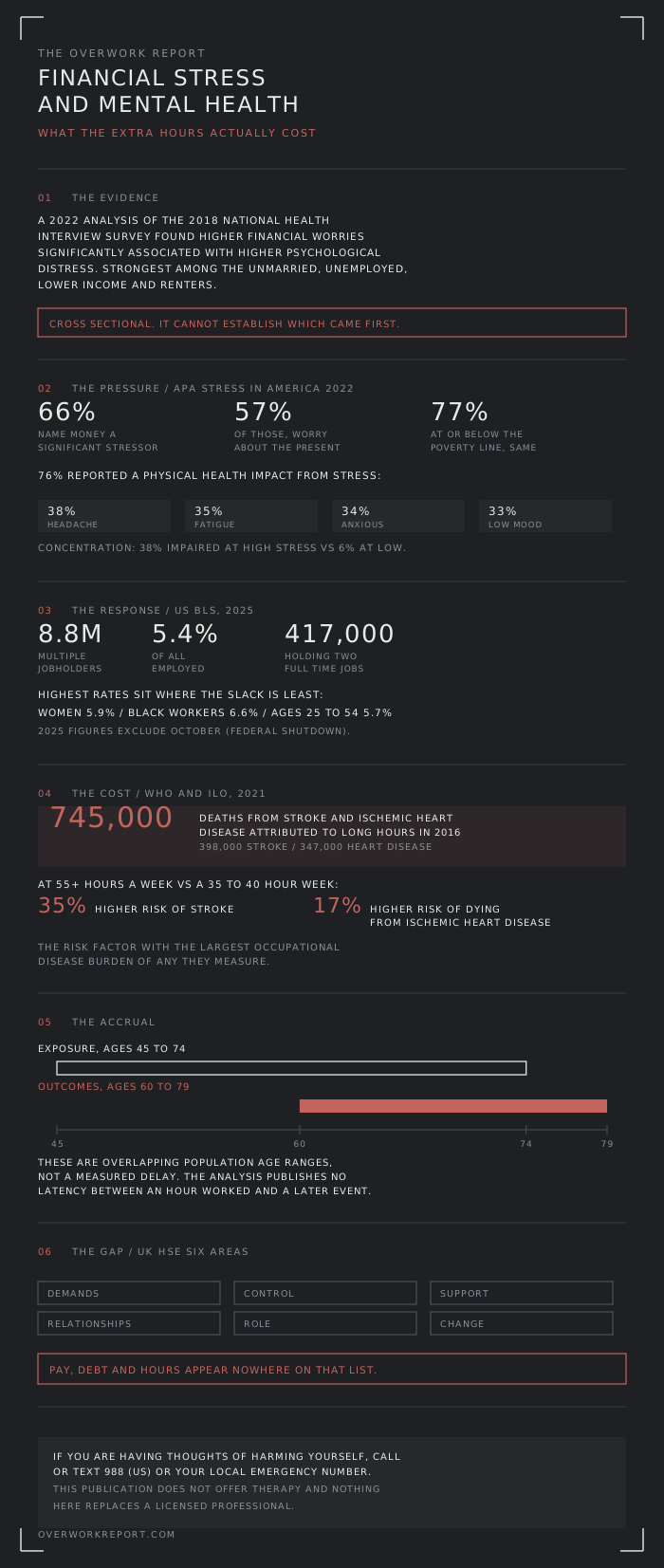
Financial stress and mental health move together in both directions, and nearly all of the evidence establishing it is correlational, which matters more than it sounds. What is not correlational is the price of the most common response to money pressure. When the bills outrun the pay, people work more hours, and the World Health Organization and the International Labour Organization estimate that working 55 or more hours a week carries a 35 percent higher risk of stroke and a 17 percent higher risk of dying from ischemic heart disease compared with a 35 to 40 hour week. That is the firmest number anywhere in this loop, and it is attached to the part almost everyone treats as the solution.
The extra hours are a transaction with two sides, and only one side of it shows up on your payslip. This page is about pricing the other one.
If you are having thoughts of harming yourself, contact the 988 Suicide and Crisis Lifeline by calling or texting 988 in the United States, or your local emergency number. This publication reports on working conditions. It does not offer therapy and nothing here replaces a licensed professional.
What the evidence establishes, and the word it will not let you use
The honest version of the finding is narrower than the headlines built on it. A 2022 analysis in the Journal of Family and Economic Issues, using the 2018 National Health Interview Survey, found that higher financial worries were significantly associated with higher psychological distress among US adults, and that the association was more pronounced among people who were unmarried, unemployed, in lower-income households, or renting rather than owning.
Read the verb. Associated. That study is cross-sectional, meaning it photographs a population at one moment rather than following people through time, so it cannot tell you which came first. The same limitation applies across most of this literature. People under financial strain report more distress, and people in distress are more likely to be under financial strain, and a single snapshot cannot separate the two.
That is not a reason to dismiss the link. It is a reason to be precise about what you are entitled to conclude from it, because the imprecise version leads somewhere expensive. If you believe money problems cause the distress in a simple one-way sense, the obvious remedy is more money, and the fastest available route to more money is more hours. The evidence does not actually support that chain as cleanly as it is usually presented.
The loop runs in both directions, which is why it is hard to step out of
The APA's 2022 survey is worth reading closely because it records what money stress does to the rest of a life rather than only how common it is. Among adults who said money was a significant source of stress, 57 percent said the main worry was having enough to pay for things in the present, such as food or rent, rather than saving for the future. That share rose to 72 percent among households under 50,000 dollars a year, and to 77 percent among those at or below the poverty level.
The same survey found that 55 percent of people stressed about money said money was a cause of fights or tension in their family, against 41 percent of the general population, and that 56 percent of all adults had made different choices in the past month because of a lack of money.
Then the mechanism that closes the loop. Across all adults, 76 percent reported a physical health impact from stress in the previous month: headache at 38 percent, fatigue at 35 percent, feeling nervous or anxious at 34 percent, and feeling depressed or sad at 33 percent. More than one in ten, 15 percent, reported using alcohol, cigarettes or drugs to relax, and among people with higher average stress levels that figure was 30 percent.
Fatigue, anxiety and disrupted sleep are not neutral to your earning capacity. They degrade exactly the faculties that solving a money problem requires. This is the shape of the thing: the pressure damages the instrument you would use to relieve the pressure. Our inventory of burnout symptoms covers what that degradation looks like from the inside, and the APA's own figures on concentration are blunt about the cost. Among adults with higher average stress, 38 percent reported an inability to concentrate against 6 percent of those with lower stress.
One caveat on the age of this data, since it is the sort of thing this publication would rather state than bury. The APA's money-specific figures above are from its 2022 survey. Its 2025 Stress in America report is built around societal division and loneliness rather than money, so the 2022 release remains the most recent APA publication with this level of detail on financial stress specifically. Treat the percentages as a picture of 2022 rather than of this month.
The standard response is more hours, and you can count it
People do not respond to a shortfall with a literature review. They pick up a shift.
The US Bureau of Labor Statistics counts this directly. In 2025 there were 8.8 million multiple jobholders, 5.4 percent of everyone employed, against 8.4 million and 5.2 percent in 2024. Two details in that table deserve more attention than the headline rate.
| Group | Multiple jobholding rate, 2025 | What it says |
|---|---|---|
| All employed, 16 and over | 5.4 percent | Up from 5.2 percent in 2024 |
| Women | 5.9 percent | Consistently above the rate for men, at 4.9 percent |
| Black or African American workers | 6.6 percent | The highest rate among the groups published, up from 6.1 percent in 2024 |
| Widowed, divorced or separated women | 7.0 percent | The highest figure in the table, and a single-income household signature |
| Ages 25 to 54 | 5.7 percent | The peak earning and peak obligation years |
| Both jobs full time | 417,000 people | Two full-time jobs at once, which is at least 70 hours a week before commuting, since the BLS counts full time as 35 hours or more |
The groups carrying the highest rates are the ones with the least slack: single-income households, and workers in the years when childcare and housing costs peak together. That is not a preference for work. It is arithmetic.
Two honest qualifications. The BLS notes that its 2025 annual estimates are 11-month averages excluding October, because data for that month was not collected during the federal government shutdown, so 2025 is not strictly comparable with other years. And multiple jobholding is not the only route to longer hours. Overtime in a single job does not appear in this table at all, which means the count above is a floor on the behaviour rather than a measure of it.
What 55 hours a week costs
The WHO and ILO published the first global analysis of the health cost of long hours in 2021. Their finding: long working hours led to 745,000 deaths from stroke and ischemic heart disease in 2016, 398,000 from stroke and 347,000 from heart disease, among people who had worked at least 55 hours a week. That was a 29 percent rise since 2000, with deaths from heart disease due to long hours up 42 percent and from stroke up 19 percent over that period.
The comparison that matters for a decision is the risk ratio. Against a 35 to 40 hour week, a week of 55 hours or more was associated with an estimated 35 percent higher risk of stroke and a 17 percent higher risk of dying from ischemic heart disease.
The scale is worth holding onto. WHO and ILO describe long working hours as responsible for about one third of the total estimated work-related burden of disease, which makes it, in their words, the risk factor with the largest occupational disease burden of any they measure.
Why the trade feels free: one side is countable and the other is not
The WHO and ILO analysis contains a detail that explains the psychology of this better than any survey does. In its own words, most of the deaths recorded were among people dying aged 60 to 79 years, who had worked for 55 hours or more per week between the ages of 45 and 74 years.
Be careful about what that does and does not say, because it is easy to over-read and we are not going to. Those are two overlapping age ranges describing a population, not a stopwatch. The analysis does not publish a latency between a given hour worked and a later event, and subtracting one age band from the other to produce a tidy number of years would be inventing a statistic the source never calculated. What it describes is risk accumulating across a working life, with outcomes concentrated in later life.
Set that against the other side of the transaction. The money from a double shift arrives within the fortnight, as a figure you can check against your bank balance. The risk accrues in a quantity nobody can observe in themselves on any given day, and it never arrives labelled. Nobody has a heart attack that announces which specific years of overtime contributed to it.
That is the asymmetry, and it is about countability rather than about timing. One side of the trade is a number. The other side is a shift in odds spread across decades, which is exactly the kind of thing human beings are worst at weighing against a number. The trade only feels free because one half of it can be counted on Friday and the other half cannot be counted at all.
It is also worth saying plainly what this does not mean. The WHO and ILO figures are population-level estimates of risk, not a prediction about you. A 35 percent higher relative risk of stroke is a meaningful shift in the odds across millions of workers and is not a sentence passed on any individual. Most people who work long hours do not have a stroke. The number tells you the direction and rough size of what you are trading.
Britain's framework for work stress has no channel for money
There is a structural reason this problem goes unaddressed at work, and Britain's regulator makes it unusually visible because it publishes the list explicitly. The United States has no single equivalent framework, so the British one is used here as the clearest worked example rather than as a description of any American employer's obligations.
Britain's Health and Safety Executive is the statutory regulator for workplace health, and it names six main areas that can lead to work-related stress if they are not managed properly: demands, control, support, relationships, role and change.
| HSE area | What the regulator says workers report | Does it capture financial pressure? |
|---|---|---|
| Demands | Not able to cope with the demands of their jobs | No. It measures the load, not why you accepted it |
| Control | Unable to control the way they do their work | No, though needing the income shrinks your real control |
| Support | Do not receive enough information and support | No |
| Relationships | Trouble with relationships at work, or being bullied | No |
| Role | Do not fully understand their role and responsibilities | No |
| Change | Not engaged when a business is undergoing change | No, except where change threatens the income itself |
Pay is not one of the six. Neither is debt, nor housing cost, nor the number of jobs a person is holding. The framework is a good one for what it covers, and what it covers is conditions inside the workplace. A worker on a second job to cover rent presents to that framework as an ordinary demands problem, and gets offered workload management for a problem that is not about workload.
This is not a criticism of the HSE, which is a workplace regulator doing workplace regulation. It is an observation about where the gap sits. The scale of what the framework does catch is substantial: work-related stress, depression or anxiety affected 964,000 workers in Great Britain in 2024/25, a prevalence rate of 2,770 per 100,000 and statistically significantly higher than the previous year, with 22.1 million working days lost. What sits outside it has no comparable count at all.
If you want the conversation that does work inside that framework, our guide to setting personal boundaries at work covers the version built for someone who is not free to simply say no, and it is honest that a boundary is easier to hold when you are not dependent on the overtime.
Finding the line for your own situation
There is no published threshold that tells you when the extra hours stop being worth it, and anyone quoting one to you has invented it. What exists is a reference point and a method.
The reference point is 55 hours. That is the figure the WHO and ILO analysis is built on, and it is a real line in the evidence rather than a round number someone liked. It says nothing about 48 hours or 52 hours, because the study did not measure those against the same comparison.
The method is to price both sides of the trade in the same units before you extend, not after.
| Question | Why it separates a good trade from a bad one |
|---|---|
| What is the actual hourly rate on the extra hours, after tax, commuting and any childcare it triggers? | The marginal rate on additional hours is frequently far below the headline rate, and occasionally negative once childcare is priced in |
| Does this have an end date that is written down somewhere? | A defined stretch is a different proposition from an open-ended one. The WHO and ILO exposure is chronic, measured across decades, not across one hard quarter |
| Is the total across all jobs above 55 hours? | The evidence is about total hours worked, not hours per employer. Two jobs of 30 hours is a 60 hour week |
| What is it displacing? | Sleep is the usual answer, and it is the one that compounds fastest. See our reporting on the effects of sleep deprivation |
| Would a cost reduction reach the same number? | Not always available and not always enough, and for a household already cutting food or heating it carries its own costs, but unlike extra hours it does not carry the stroke and heart disease risk this page is built on |
| Has anything in the APA list appeared yet: sleep change, constant worry, using alcohol to relax? | Those are the reported consequences of sustained stress, and their arrival is information about where you already are |
The last row is the one most worth acting on, because it is the only item on the list that reports on your actual current state rather than your plan. If several of those are already present, the question is no longer whether to add hours. Our account of how to recover from burnout without quitting is written for exactly the situation where leaving is not financially available.
When this is not a problem more hours can solve
Some financial situations do not respond to additional work at all, and recognising one early saves a great deal of unnecessary damage. Debt at high interest can outrun what extra shifts bring in. A shortfall driven by medical costs, a sudden loss of household income, or an obligation that grows faster than earnings is a structural problem, and structural problems need restructuring rather than effort.
In those cases the productive move is a free debt advice service, a creditor conversation, or a benefits check, none of which cost you hours or health. Working harder against an arithmetic problem is the most expensive way to not solve it.
There is also a threshold at which this stops being a financial question. Financial distress is widely recognised in public health literature as a contributor to mental health crisis, and if money worry has reached the point of thoughts of self-harm, that is a medical situation and not a budgeting one. Contact the 988 Suicide and Crisis Lifeline by calling or texting 988 in the United States, or your local emergency number. Speak to a licensed professional or your doctor. This publication reports on working conditions and does not provide therapy, medical advice or financial advice.
FAQ
How does financial stress affect mental health?
The established finding is an association rather than a demonstrated cause. A 2022 analysis of the 2018 National Health Interview Survey found higher financial worries significantly associated with higher psychological distress among US adults, with the association strongest among people who were unmarried, unemployed, in lower-income households or renting. Because that data is cross-sectional, it cannot establish direction. What the APA's 2022 survey adds is what people report alongside it: among all adults, 76 percent reported a physical health impact from stress in the previous month, most commonly headache, fatigue, anxiety and feeling depressed or sad, and 15 percent reported using alcohol, cigarettes or drugs to relax.
Can financial stress cause physical health problems?
The clearest evidence runs through the response rather than the stress itself. The WHO and ILO estimate that working 55 or more hours a week is associated with a 35 percent higher risk of stroke and a 17 percent higher risk of dying from ischemic heart disease compared with a 35 to 40 hour week, and attribute 745,000 deaths in 2016 to long hours. Since additional work is the most common answer to a shortfall, that is the pathway with the firmest numbers attached. Separately, the APA's survey records a range of self-reported physical symptoms accompanying high stress of any origin.
How many hours a week is too many?
The only threshold with population-level evidence behind it is 55 hours, which is the line used in the WHO and ILO analysis. That study compared 55 or more hours against 35 to 40 hours, so it says nothing directly about 45 or 50 hour weeks. Two points people miss: the figure counts total hours worked rather than hours per employer, so two 30 hour jobs put you over it, and the exposure measured was chronic, across the ages of 45 to 74, rather than one demanding quarter.
Is working a second job bad for your mental health?
The count itself is not the risk. In 2025 the US Bureau of Labor Statistics recorded 8.8 million multiple jobholders, a rate of 5.4 percent, and most of them are not in the risk band the WHO and ILO measured. What matters is the total weekly hours across all jobs, how long the arrangement runs, and what it displaces, which is usually sleep. A second part-time job that keeps total hours under 55 and has a written end date is a different proposition from an open-ended arrangement that pushes the week past 55.
Why does working more feel like the obvious solution when money is tight?
Because only one side of it can be counted. The income arrives within a fortnight as a figure you can check. The cost is a shift in population odds that accumulates invisibly: in the WHO and ILO analysis most deaths attributed to long hours occurred between the ages of 60 and 79, following exposure between the ages of 45 and 74. Those are overlapping age ranges across a working life rather than a measured delay, and no cardiac event arrives labelled with the years of overtime that contributed to it. A number on one side and an unobservable accrual on the other is not a fair comparison, which is why the decision feels one-sided when you make it.
Will my employer's wellbeing programme help with this?
Probably not with the financial part, and the reason is structural rather than a failure of intent. The Health and Safety Executive names six areas as causes of work-related stress, demands, control, support, relationships, role and change, and pay appears in none of them. A worker taking extra hours to cover rent registers within that framework as a demands problem and is likely to be offered workload management, which does not address why the hours were accepted. The framework covers conditions inside the workplace, and this pressure originates outside it.
What should I do if extra hours are not closing the gap?
Treat it as an arithmetic problem rather than an effort problem. If a debt is growing faster than the additional income, or the shortfall comes from medical costs or a sudden loss of household income, more shifts will not reach it and will cost you sleep on the way. The levers described in the section above carry no health price, and they act on the balance rather than on your capacity to service it. Run the checks in the table above. If the marginal rate on the extra hours comes back near zero, the arrangement has no written end date, or the total across all jobs is already past 55, the structure is the problem and not the hours.
When does financial stress become a medical situation?
When it reaches thoughts of harming yourself, it is a medical situation and not a budgeting one. Contact the 988 Suicide and Crisis Lifeline by calling or texting 988 in the United States, or your local emergency number, and speak to a licensed professional or your doctor. The same applies if the signals in our burnout symptoms inventory have been present for months rather than weeks. This publication reports on working conditions and does not provide therapy, medical advice or financial advice.
Last reviewed by The Overwork Report Editorial Team on September 16, 2026. Our sourcing and AI-use rules are public on the editorial standards page.
Sources
- 988 Suicide and Crisis Lifeline (988lifeline.org)
- higher financial worries were significantly associated with higher psychological distress (pmc.ncbi.nlm.nih.gov)
- 57 percent said the main worry was having enough to pay for things in the present (apa.org)
- 2025 Stress in America report (apa.org)
- 8.8 million multiple jobholders (bls.gov)
- 745,000 deaths from stroke and ischemic heart disease in 2016 (who.int)
- six main areas that can lead to work-related stress (hse.gov.uk)